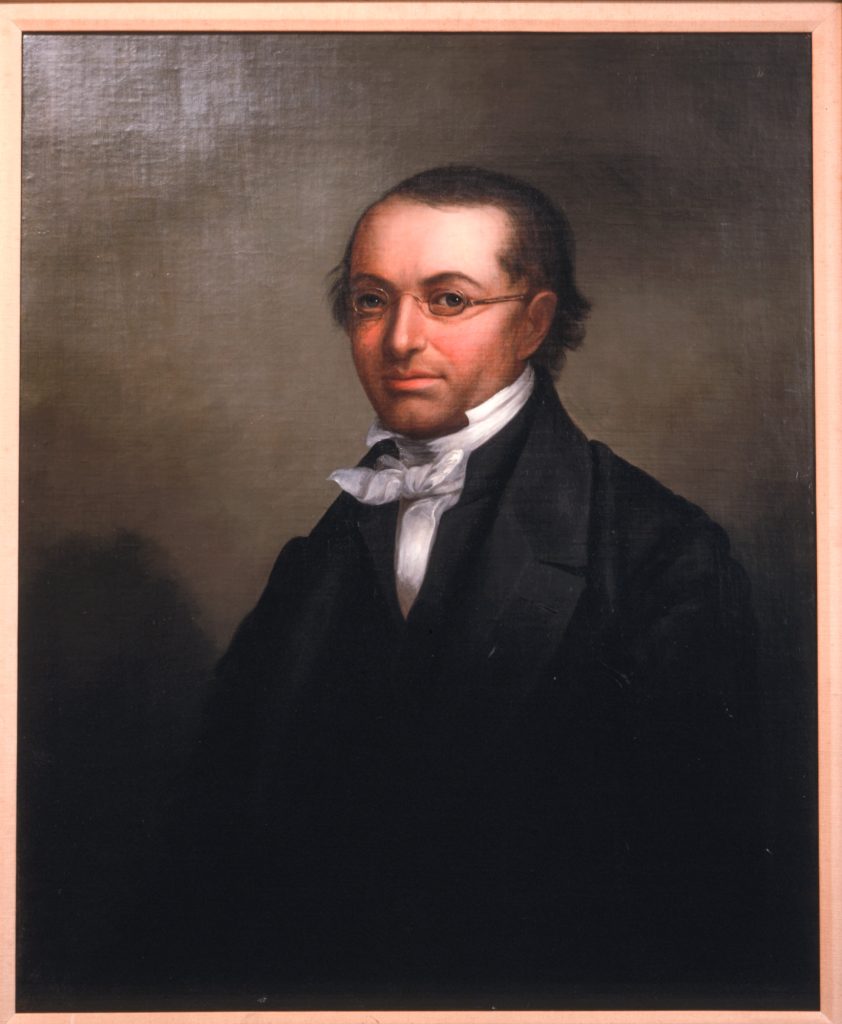
Over the course of four decades, Isaac Leeser filled a variety of significant roles in American Jewish life—scholar, hazan, writer, editor, publisher, organizer, compiler and translator. He was, in fact, the most important American Jewish figure of his day.
Leeser’s upbringing in Westphalia was peripatetic, and his education inconsistent, owing in part to several family relocations and in part to the early deaths of both his parents—his mother when he was 8,and his father and paternal grandmother six years later. Thus orphaned, the 14-year-old Leeser made his way to Műnster, with the help of a benefactor, to continue his education at the Műnster Institute. This secular academy maintained a rigorous course of study, and Leeser’s studies there included Greek, Latin, history, geography, mathematics, and physics, which Leeser added to his earlier studies in Hebrew and Jewish texts from the Jewish schools at Dulmen. By age 17, he had completed his education and accepted an invitation from his maternal uncle, Zalme Rehine, to come to the United States. He traveled alone and joined his uncle at Richmond, Virginia, in early May of 1824.
Embraced by the Jewish community in Richmond, Leeser quickly imbibed American ideals and became a proponent of Jeffersonian republicanism. He was soon encouraged by his uncle and new American friends, who noted his skill as a teacher and scholar, to pursue a career in the synagogue. Among his mentors at Richmond were a number of learned men who played an influential role in shaping Leeser’s career ambitions: Baruch Hillel Judah, who served as Librarian for the Richmond Library Company, Isaac B. Seixas, who taught Leeser the Sephardic mode of worship and engaged him as a Sabbath and day school teacher, Jacob Mordecai, parnas of Congregation Beth Shalome and author of a number of scholarly manuscripts, and Israel Baer Kursheedt, the leading expert on Jewish law in America. The publication of several of Leeser’s letters defending Judaism in a Richmond newspaper soon brought him public renown among American Jewry and, as a result, in 1829, Leeser wrote his first book manuscript, entitled The Jews and the Mosaic Law, and was offered the post of hazan at Congregation Mikveh Israel in Philadelphia, where he replaced the late Abraham I. Keys.
The early years of Leeser’s tenure in Philadelphia saw the development of two key innovations that were among his greatest contributions to American Judaism. First, inspired by the Reform movement among Jews in Germany, Leeser standardized the practice of giving sermons in English language at Mikveh Israel. Then, after several difficult attempts to find publishers for his manuscripts, Leeser opened his own publishing firm, the American Jewish Publication Society, in 1845. This was the first press in the United States with an explicit focus on Jewish texts and as well as the first national Jewish institution devoted to advancing Jewish culture.
Leeser also continued his own scholarly work, authoring prayerbooks, religious readers, and political tracts as well as essays and sermons. From 1830 until his death, less than forty years later, Leeser published dozens of volumes in Jewish theology, history, and liturgy, and introduced the work of important Jewish authors such as Moses Mendelsohn and Grace Aguilar to an American audience through his editing and translation of their work. Leeser’s Catechism for Younger Children (1839) served as the key educational text in the Hebrew Sunday School founded by Rebecca Gratz, and laid the cornerstone of American Jewish pedagogy for several generations.
In 1843, Leeser founded The Occident and American Jewish Advocate, the first sustained publication of Jewish interest in the United States, with the stated purpose “to give circulation to every thing which can be interesting to the Jewish inhabitants in the western hemisphere.” Leeser would continue as principle editor and publisher of The Occident until his death, using the paper to highlight Jewish causes, publish important sermons and advocate for national Jewish institutions and a better system of allocating resources to Jewish charities. Among the many charitable institutions he helped to found in Philadelphia were the Hebrew Education Society (1847), the Jewish Foster Home (1850), the Jewish Hospital (1866), and Maimonides College (1867). The latter was the first Jewish theological seminary in the United States, and Leeser served as its founding president. He was also a founding Vice President of the Board of Delegates of American Israelites in 1859, and held that post until his death.
Leeser, who never married, was never popular with the congregation at Mikveh Israel, and he retired from this post in 1850 amid a hail of controversy, to be replace by Sabato Morais. Determined to support himself as a freelance writer, Leeser then announced several publication projects in addition to The Occident and turned down offers from congregations in Charleston and Sydney, Australia. He made a four month tour of the Western states, visiting 25 Jewish communities, raising readership for The Occident and identifying subscribers for his project to translate the Hebrew bible into English, which was completed in 1854 to critical acclaim. Several years later, he took up the post of hazan at a newly formed Sephardic congregation, Beth El Emeth in Philadelphia, where he officiated until his death in 1868 at age 62.