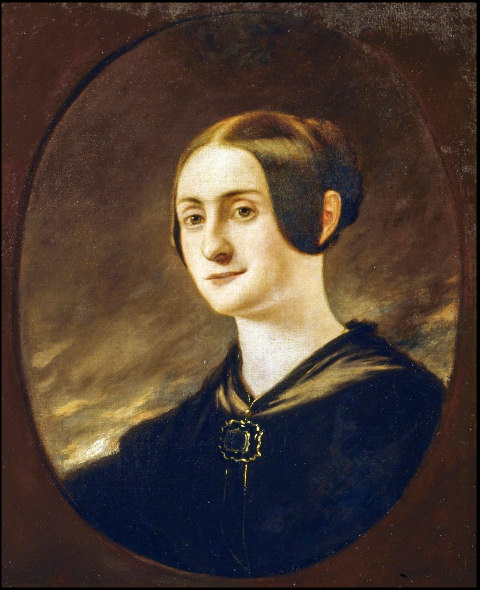
Writing about her aunt Penina Moïse, who had devoted her life to poetry, liturgy, and education, Jaqueline Levy recalled:
She looked with coldness on nothing that God had made; the flowers were dear to her as spirit messengers from the Great Bestower of beauty. The outer world spoke to her soul, whispering of eternal love and mercy, and the early recognition of her nearness to God and her fellow-beings gave her thought the eminent religious tone that pervaded so much of what she wrote.
The daughter of Abraham and Sarah Moise, Penina was born in Charleston. Originally from Alsace, her father had worked as a merchant in the Caribbean, where he met and married her mother on the island of Sint Eustatius. Although her father’s fortunes in business were mixed, her large family—she had nine siblings—played a prominent role in Jewish life in Charleston. They were members of Congregation Beth Elohim and her father was a founder of the Hebrew Orphan Society.
After her father’s death, at the age of twelve, Moïse left school, and played the role of family nurse, caring for her mother and her brother Isaac, who suffered from asthma. She demonstrated a passion for language, and her siblings Jacob and Rachel encouraged her poetic ambitions.
Moïse published her first poem in 1819, and thereafter her work regularly appeared in such venues as the Charleston Courier, the Boston Daily Times, the New Orleans Commercial Times, the Washington Union, Godey’s Ladies Book, the Home Journal of New York Occident, and the American Jewish Advocate. In 1833, she released Fancy’s Sketch Book, the first poetry collection by an American Jewish woman. In verse, she addressed a range of subjects—love, death, nature, current events, Greek mythology, antisemitism, and history. Often romantic and sentimental, her work was also marked by wit and wordplay, ranging from lyric to light satire. She also wrote columns for newspapers throughout the country.
Penina’s creative spirit was not confined to poetry. She was a great lover of music and an amateur painter, even giving lessons to her nephew Theodore, who would become a celebrated portraitist. Her portrait, and several others in this collection, were done by him. The Moise family also remained deeply engaged with Congregation Beth Elohim. In 1841, Penina’s brother Abraham and Isaac Harby led efforts to liberalize the congregation and affiliate with Reform Judaism. For the new rite, new liturgy was needed, and of course they turned to Penina. In 1842, she published Hymns Written for the Use of Congregation Beth Elohim, and she would continue to compose hymns, eventually producing some hundred and ninety. In 1842, she became superintendent of the Beth Elohim’s Sunday school.
During the Civil War—in which she was a staunch defender of the Confederacy— Moïse left Charleston for Sumter. Meanwhile, her health was deteriorating and she was losing her sight. Moïse was cared for by her widowed sister Rachel Levy and Rachel’s daughter, Jaqueline. Although ill and in much reduced circumstances, she returned to Charleston after the war, where she ran an academy with her sister and niece. She continued writing poetry, undaunted by blindness and illness. A year before her death she wrote:
But why should I not wish to linger here? Do I not dwell in friendship’s atmosphere, where generous souls such balmy tribute bring. As makes my wintry age so like the spring that scarce the blind recluse, amid its snows, detects the absence of the vernal rose?
In 1911, twenty-one years after her death, the collection Secular and Religious Works of Penina Moise appeared. Thirteen of her hymns were included in the Reform movement’s 1932 Union Hymnal. An epitaph she composed shows a slight corrective to the uncomplaining optimism that seems otherwise to have defined her poetry and character:
Lay no flowers on my grave. They are for those who live in the sun and I have always lived in the shadow.