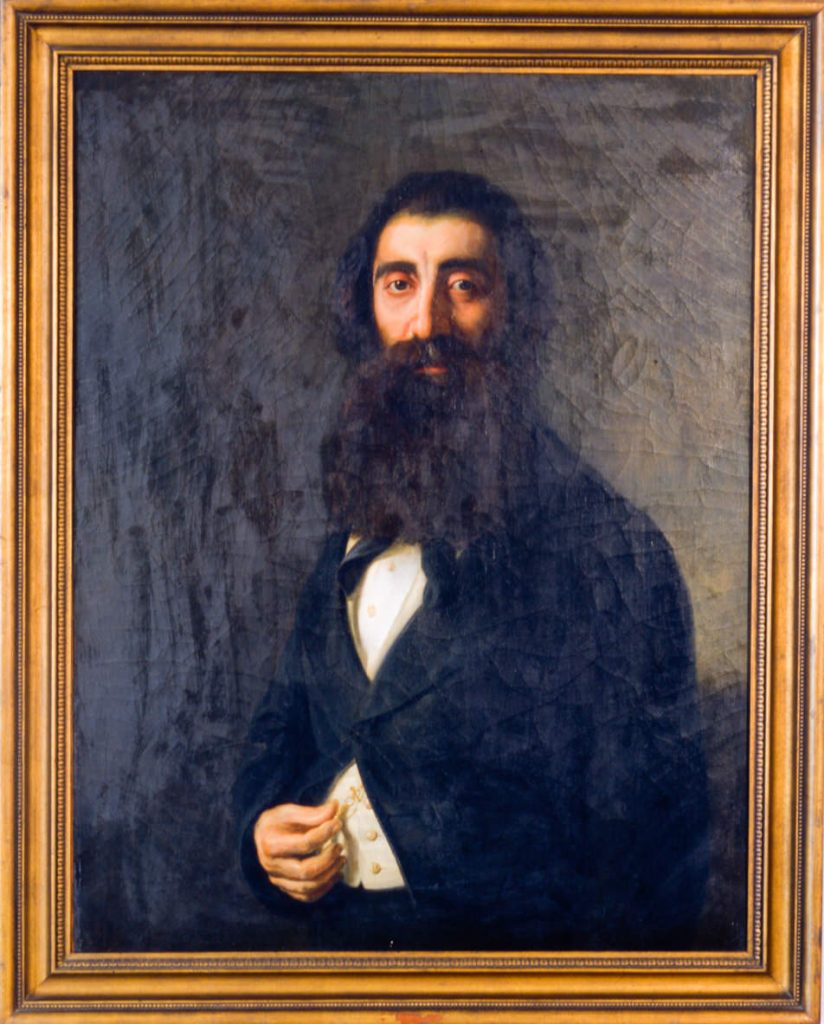
The seventh of nine children and youngest son of Israel Baer Kursheedt and Sarah Abigail Seixas, Gershom Kursheedt was imbued from both sides of his family with a profound connection to Judaism. His father, a respected elder at the time of Gershom’s birth, was the most Talmudically learned person in the United States of his day, and widely consulted on questions of Jewish law. His maternal grandfather, Gershom Mendes Seixas for whom he was named, had been the first widely recognized public representative of American Judaism. With such an inheritance, Gershom Kursheedt was biologically disposed to love learning and Jewish causes.
Kursheedt moved to New Orleans at age twenty-one to work in an uncle’s retail business. By 1845, he was serving as the publisher of the New Orleans Commercial Times, a post he would hold for another four years. Kursheedt became involved in charitable work in the city, helping to raise funds for those suffering from the yellow fever and cholera epidemics. He also joined the freemasons. Around this time, his concern with the Jewish condition grew. “I have but one ambition in life,” he would write to Isaac Leeser in 1848, ”and that is to elevate the character of ourpeople in the eyes of God and man.”
Dissatisfied with the state of Jewish communal life in New Orleans—the rabbi, Kursheedt believed, was a charlatan whose personal beliefs were Christian, and the community lacked such basics as a torah and a shofar—Kursheedt sought to establish a new synagogue. In order to raise funds for this endeavor, he befriended one of the wealthiest men in New Orleans, Judah Touro. Touro was then little identified with the Jewish community, making most of his philanthropic efforts among other kinds of institutions with which he was affiliated. However, Kursheedt persuaded him of the importance of Jewish institutions to the communal welfare of the Jewish people, in part by reminding Touro of the traditions to which Touro’s own father, the founding hazan of the synagogue in Newport, Rhode Island, had devoted his life. At Kursheedt’s behest, Touro purchased and renovated an abandoned church in the downtown section of the city, and then funded the salary of a rabbi. Kursheedt then arranged a consecration ceremony for the new synagogue, to be named Nefutzoth Yehudah (“the dispersed of Judah”) in Touro’s honor, with Kursheedt as its first parnas. Touro was so moved by the dedication ceremony that it was said to have sparked his return to Judaism. He regularly joined the new congregation for worship, and funded the construction of a congregational school.
Kursheedt’s commitment to the Jewish community in New Orleans spread beyond the borders of Congregation Nefutsoth Yehudah. He founded the Hebrew Benevolent Society to attend to Jewish social welfare and, after the 1853 yellow fever epidemic left the Society with a number of widows and orphans in its charge, he persuaded Touro to build a home for Jewish widows and orphans. Kursheedt worked closely with Touro for the benefit of Jewish communal institutions until the end of Touro’s life in 1854. He was named co-executor with Sir Moses Montefiore of Touro’s will, and the two collaborated in executing Touro’s bequest to build an almshouse for the Jewish poor in Palestine.
In 1861, Kursheedt married Grace Guedalla, but the marriage did not produce any children. Sadly, Kursheedt died in London at age forty-six just two years later. Grace would go on to marry Kursheedt’s older brother Alexander, also recently widowed, in 1867.