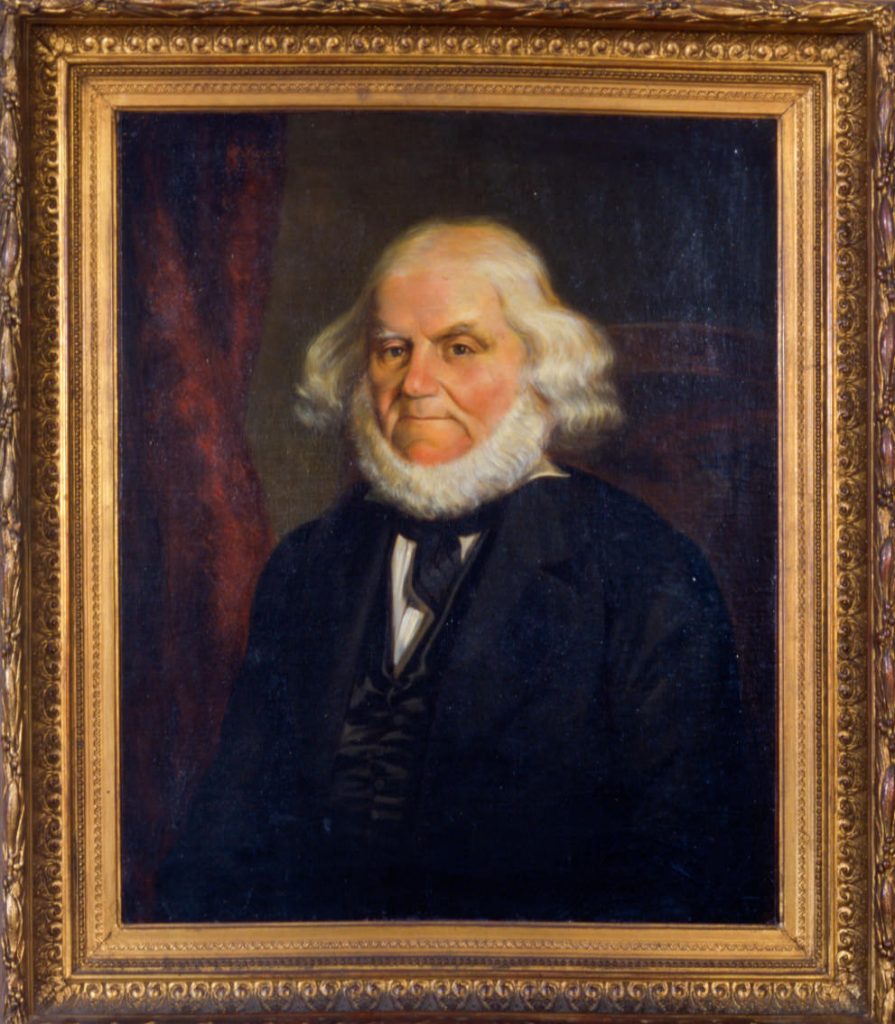
Israel Baer was born in Singhafen, a town on the Rhine, during Passover 5526. After his father’s death, when he was still very young, his mother moved the family to the village of Kursheidt, near Koenigswinter. When German civil authorities required that Jews take proper surnames, Kursheedt took the name of the village in addition to the patronymic Baer. Kursheedt’s precocious aptitude for learning drew the attention of family friends, and he was soon sent to Franfurt-am-Main to study in the yeshiva of the famed cabalist and Talmudist Rabbi Nathan Ben Simeon Adler referred to Kursheedt as chakham (wise man), and indeed his American contemporaries knew Kursheedt as the most Talmudically adept scholar in the United States of his day. He was certainly the first Jew in North America with such an impressive mastery of Jewish religious texts.
Kursheedt’s studies in Frankfurt were interrupted when war broke out with France, and he was forced into commerce instead. He had some success as a supplier of provisions to the Prussian Army, but when peace was declared his career as an army contractor ended, and he resolved to seek his fortune elsewhere. In Hamburg, his attention was drawn to a boat bound for a return trip to Boston. He quickly secured letters of introduction to Moses Michael Hays at Boston and Isaac Moses at New York, and arrived in the United States in 1796 after a two and a half month passage.
In New York, Kursheedt resumed his commercial activity with the assistance of Isaac Moses, then parnas of Shearith Israel. He soon became acquainted with Gershom Mendes Seixas, Shearith Israel’s hazan. There can be no doubt that Seixas was enthralled by Kursheedt’s erudition, and Kursheedt foundhimself welcomed in the Seixas home. In 1804, at age 38, he would marry Sarah Abigail, then 26, the eldest of Seixas’ children by his beloved first wife, Elkaleh Myers-Cohen.
Eight years later, Kursheedt moved the family, now comprising two daughters and two sons, to Richmond, where he had been offered a post as hazan to Congregation Beth Shalome. The Kursheedts would live in Richmond for another decade, accumulating five more children–two sons and three daughters–along the way. Among their children were future leaders of American Jewry, Asher and Gershom. During their sojourn, Sarah wrote frequently to her father, with whom she remained close. Meanwhile, Kursheedt himself developed something of a friendship with Thomas Jefferson, and was invited to visit him at Monticello.
In both New York and Richmond, Kursheedt became involved in Jewish communal institutions, assisting in the upkeep of the local cemetery and playing an important role in Jewish education. Despite his own traditional education, Kursheedt was reform minded. He quickly found himself at odds with a number of influential members of Shearith Israel. Though widely respected for his learning, he often lost the battles he chose to fight. In 1809, for example, Kursheedt and other congregants attempted, without success, to limit the number of prayers in honor of a donor to three per person, as these prayers had become linked to elaborate public displays of wealth.
After his return to New York in 1824, Kursheedt was caught in the middle of the interethnic tensions within New York’s Jewish community, which came to the fore with the increasing arrival of German Jews. He soon helped to establish an Ashkenazi minyan, or prayer group. When the Sephardi board of elders tried to prevent the Ashkenazim from meeting for prayer, Kursheedt and fifteen other members of Shearith Israel formed a new Ashkenazi congregation, named B’nai Jeshurun. This became New York’s second synagogue. Kursheedt devoted himself to the development of the new institution. His last major communal effort came about during the Damascus Affair in 1840, when he organized and presided at a public meeting to express sympathy for the sufferings of the Jews of Syria–an act that was copied by other American Jewish communities. He died twelve years later in New York, surrounded by friends and family, at age 86.