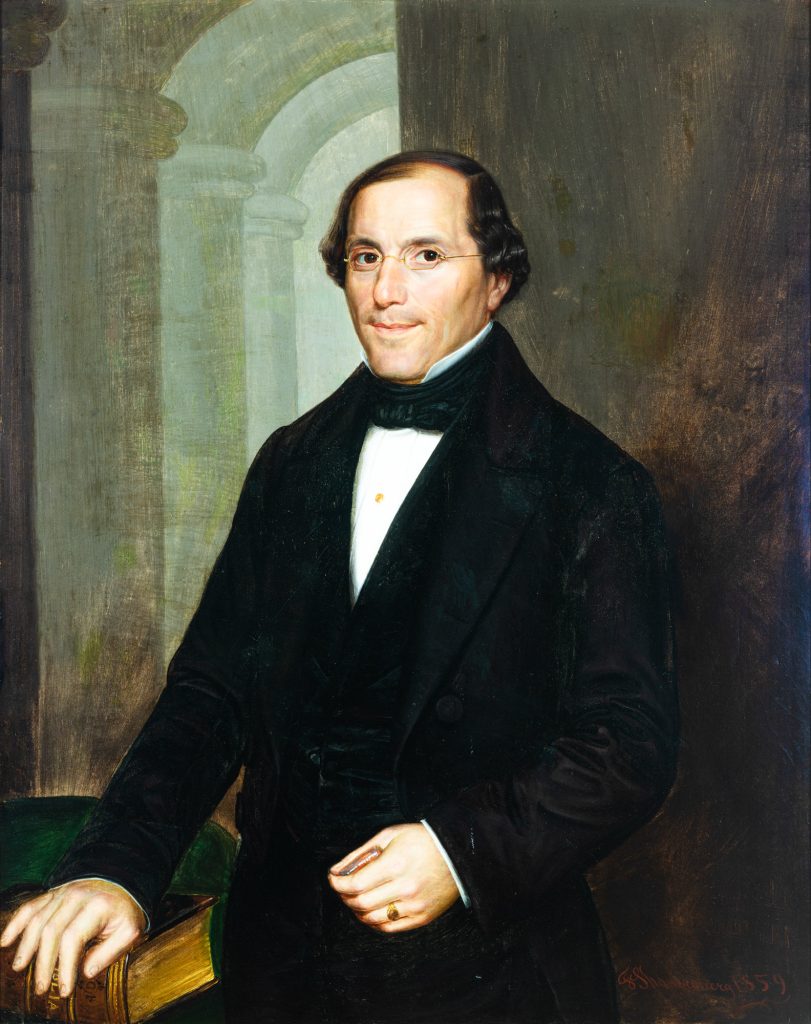
Born in 1810, in the town of Oettingen in Bavaria, Moses Michelbacher was the son of Jakob Nathan Michelbacher and Adelheid Michelbacher. His name was Marx at birth, but he changed it to Max when, in 1844, having completed his education in Germany, he set sail for the United States. He settled first in Philadelphia where, in 1845, he married Mary Traubel, also from Bavaria.
Meanwhile, the German Jews who had been coming to Richmond were feeling ill at ease in the Sephardi congregation, Beth Shalome, and so, in 1841, they formed their own, Beth Ahabah. Initially services were led by Myer Angle, but by 1846 they had determined that a teacher and religious authority was needed. Michelbacher’s knowledge of Hebrew and Jewish learning were well known—and rare commodities in the United States—and so, thirty-three members of Beth Ahabah raised funds to bring him down from Philadelphia.
In Richmond, he led services and threw himself into his new role as a communal leader. He founded the respected Richmond German, Hebrew, English Institute and, in 1848, consecrated the congregation’s synagogue, for which he had helped raise funds. In 1849, he helped organize the Ladies’ Hebrew Association, the principal charity in the Jewish community.
Just after their third child was born, in 1849, Mary died, and the following year Michelbacher married Miriam Angle, daughter of the former lay leader of Beth Ahabah, and they would have five children.
Like most of his congregants, Michelbacher was a staunch supporter of slavery, the Confederacy, and secession. During the war, he came to see himself as the leader and protector of all Jews serving in the Confederate army, and in this role attempted to secure furloughs for soldiers to celebrate Jewish holidays. He also composed a prayer for the Confederacy to be read by soldiers and congregants. It includes the lines:
This once happy country is inflamed by the fury of war; a menacing enemy is arrayed against the rights, liberties, and freedom of this our Confederacy…Our firesides are threatened; the foe is before us… Here I now stand with many sons of the South, to face the foe, drive him back, and defend our natural rights.